
Leon Fieldnotes
Leon casino licensing and Australian law
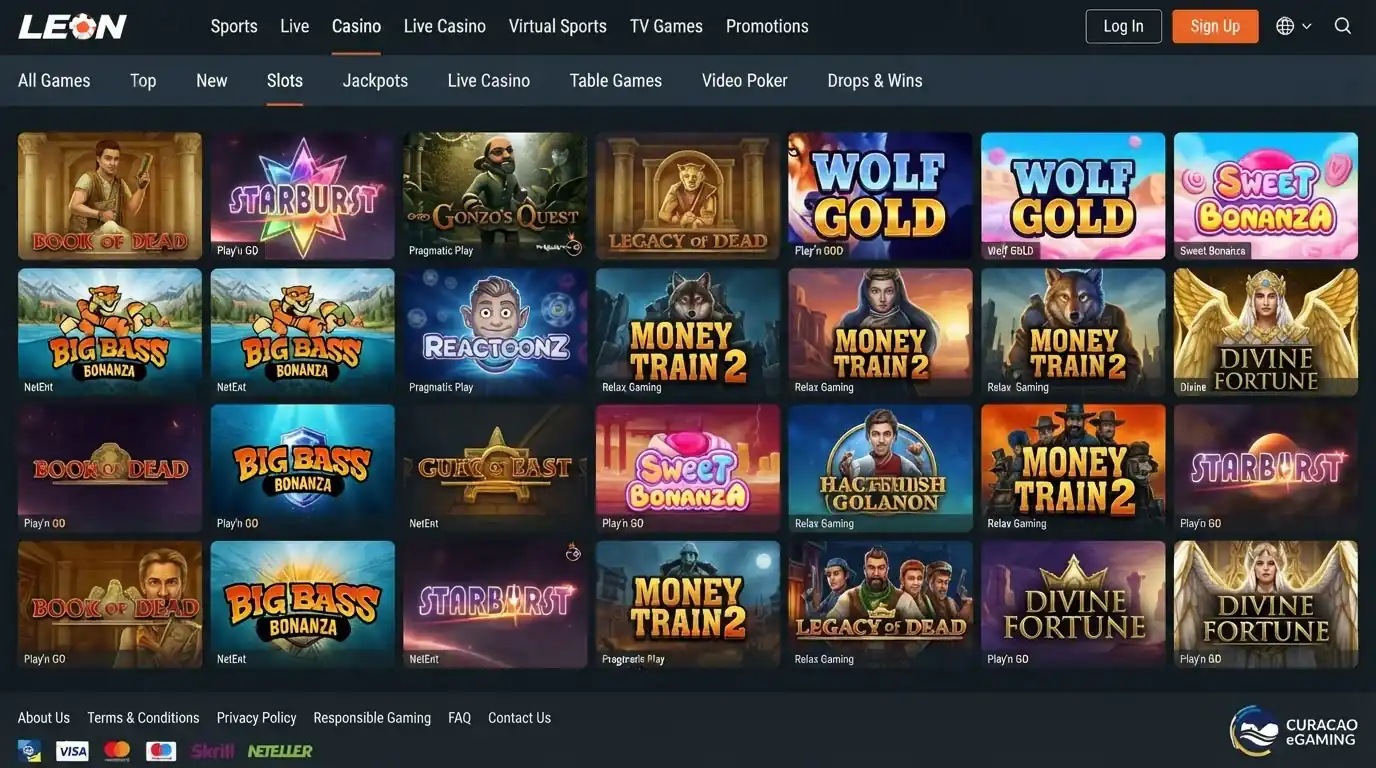
Leon combines a large international casino catalogue with a company and licensing history that must be read against Australian law. Its casino games cannot be lawfully supplied to people in Australia, and the operator’s own terms exclude Australian account registration. The regulatory history also names specific Leon domains, making the distinction between a brand, its operating entity and its claimed licence especially important.

Table of Contents
- Why Leon casino play is prohibited in Australia
- What ACMA did in relation to Leon domains
- The operator named in Leon’s current terms
- Kahnawà:ke’s warning about Leon sites
- Consumer complaints and possible remedies
- Practical legal distinctions for Australian readers
- Tax treatment remains a separate question
- Questions about Leon licensing
- The key difference is permission to supply the service
Why Leon casino play is prohibited in Australia
Australia’s Interactive Gambling Act 2001 prohibits the supply of online casino services to people who are physically located in Australia. That includes internet slots and other casino-style games delivered remotely. The legislation concerns the service being supplied, not merely where the operator maintains a company or which foreign licence appears in its terms. An overseas authorisation does not transform an otherwise prohibited Australian service into a permitted one.
Leon adds a separate contractual barrier: clause 2.3 of its terms includes Australia among the places from which an account cannot be registered. The two restrictions address different questions. Australian law sets the domestic boundary for supplying online casino games, while the operator’s own account terms define a prohibition on accepting registrations. Neither depends on whether an international casino catalogue happens to appear in search results or on a device.
Australia distinguishes online casino games from some forms of licensed interactive wagering. A reader should not treat the existence of a licensed online betting market as permission for remote casino slots or live-dealer tables. Even if the same global brand operates a sportsbook and casino, the legal position turns on the specific service. The casino product described in this editorial reference is not an Australian licensed online-casino offering.
The account conditions reinforce why sign-up eligibility and the casino games themselves must be considered separately. Device access, an international brand identity, or a payment currency such as AUD does not prove eligibility. An account currency is an accounting setting, not a grant of Australian market access.
What ACMA did in relation to Leon domains
The Australian Communications and Media Authority (ACMA) enforces the interactive-gambling regime through investigations and measures aimed at unlawful overseas services. Its January–March 2025 action report records a formal warning to Moonlite N.V. concerning Leon Casino and the inclusion of leon.bet and leon.casino on a list of websites subject to blocking. These are specific regulatory actions relating to the Leon name and domains, rather than a generic warning about casino websites.
Website blocking is an enforcement measure directed at access to an identified service. It should not be mistaken for an individual determination of a player’s liability, a ruling on every possible affiliated domain, or evidence that a payment to an operator has already been recovered. A site might remain discoverable through third-party links even after an ACMA report identifies it; search availability and regulatory permission are separate concepts.
The 2025 ACMA notice identifies Moonlite N.V. in connection with that enforcement period. Leon’s current terms instead identify Jade Reef Ventures Corp. as the operating company. The different corporate names reflect documents tied to different contexts and dates. Treating Moonlite N.V. as the current company solely because it appears in ACMA’s historical report would misdescribe the present terms. Likewise, the present terms do not erase the regulator’s earlier enforcement record.
For first-hand Australian regulatory context, the ACMA’s public material explains prohibited interactive gambling services and how to assess an online operator’s legal status. Its website is acma.gov.au. The significant practical point is that an Australian customer cannot infer local consumer protection from an overseas service’s polished presentation or from a foreign corporate address.
The operator named in Leon’s current terms
Leon’s current terms name Jade Reef Ventures Corp., registered in Belize under number 42967, as the operator. They also identify Chessmate Limited in Cyprus as a payment agent. An operator and a payment-processing agent perform different contractual roles. The processor named in a payment-related clause does not automatically become the casino operator, a gambling regulator or the guarantor of a player’s balance.
The same terms present an Anjouan, Union of Comoros gambling authorisation with identifier ALSI-202410001-FI1. The Anjouan licensing register exists publicly, and a third-party register-derived listing associates the identifier with Jade Reef Ventures Corp. and the Leon domain. However, the accessible official register material did not independently display the relevant holder-and-domain row in a way that allows that full association to be treated as a direct regulator check. The identifier is therefore best understood as the authorisation cited by the operator, with the domain connection requiring care.
Anjouan and Australian authority answer different legal questions. A purported Anjouan permission concerns an offshore regulatory framework; Australian restrictions concern supplying a service to people in Australia. The former does not override the latter. This distinction matters especially when a promotional page offers games globally without separating customer eligibility by location.
The brand has older third-party profiles naming a different operator and other licence jurisdictions. Historical descriptions can be useful for interpreting archived complaints or earlier terms, but they should not be silently joined with the current Jade Reef record as if they described one simultaneous licence arrangement. When evaluating a disputed transaction, the actual contract date and legal entity in force at that time matter more than a merged list of operators found across years.
Kahnawà:ke’s warning about Leon sites
The Kahnawà:ke Gaming Commission published an advisory dated 18 September 2025 identifying Jade Reef Ventures Corp. and domains including leon.bet and leon.casino. The Commission stated that the specified sites were not authorised, licensed or regulated by it. This is a statement from the commission about its own licensing scope, not a ruling that every offshore licence asserted elsewhere is necessarily false.
That warning is particularly relevant because older reviews have attributed Kahnawà:ke licensing to a Leon-related operation. The dated commission notice should take precedence over those older descriptions when answering whether these named domains are regulated by Kahnawà:ke. At the same time, the notice does not create an Australian authorisation. Both questions are separate from the Australian prohibition.
Readers assessing any casino identity should distinguish three layers: the trading brand displayed on screen, the contractual operator identified in the terms, and the regulator responsible for a specific licence. A brand can keep its public name while changing companies or payment agents. A country listed in a company address is not automatically a regulator. A familiar licensing logo is not proof that an individual domain falls within that licence.
A useful documentary sequence in a genuine account dispute is to establish the exact service domain, the dated terms applicable to the account, the named operating company, and the dated response from any claimed licensing body. This avoids assuming that a sister brand, mirror or historical entity shares the same consumer obligations. The payments section explains related contractual deductions and withdrawal mechanics without treating those conditions as proof of Australian eligibility.
Consumer complaints and possible remedies
ACMA can receive information about suspected illegal interactive gambling services and use its enforcement powers. Its online guidance is the appropriate starting point for reporting a suspected unlawful service supplied to Australians. Regulatory reporting and obtaining repayment are different processes: ACMA’s involvement should not be understood as a promise to resolve a particular private account dispute or recover a transfer.
Leon’s terms also set internal deadlines. They distinguish disputes about a game result, which must be raised within 14 calendar days, from account and transaction matters such as cashouts or suspensions, which have a 30-calendar-day submission window. The terms envisage an internal resolution period of 30 calendar days. These periods are contractual processes; they are not substitutes for any separate rights or duties that Australian law may create.
When a dispute exists, preserving the underlying record is essential: account statements, transaction identifiers, support replies, withdrawal requests, game history and the relevant version of the terms can explain what happened. A payment confirmation establishes movement of money, but not necessarily that a casino accepted a withdrawal request or completed a verification check. Conversely, a promised support response is not the same as an actual funds transfer.
The role of an international complaint platform can differ from that of a regulator. Independent casino review and complaint services often facilitate exchanges or publish outcomes, but they cannot be assumed to exercise Australian statutory powers. Before sharing sensitive identity material, consider whether the requested party is genuinely the intended recipient; account documents and cryptocurrency transaction identifiers deserve careful handling.
For issues involving personal liability, recovering disputed funds, or cross-border consumer rights, seek tailored advice from a qualified Australian lawyer or consumer service. A foreign gambling licence may offer a separate complaint route under its own conditions, but it cannot be represented as equivalent to an Australian licensed online-casino framework.
Practical legal distinctions for Australian readers
| Question | Relevant authority or document | Practical consequence |
|---|---|---|
| May an overseas operator supply online casino games in Australia? | Interactive Gambling Act 2001; ACMA guidance | Supply of prohibited online casino services is not lawful simply because the provider is offshore. |
| Does Leon accept Australian account registration? | Leon terms, clause 2.3 | Australia is an excluded registration jurisdiction. |
| Which company is named in the current agreement? | Leon terms | Jade Reef Ventures Corp. is the contractual operating entity listed. |
| Is Kahnawà:ke licensing asserted for the named Leon domains? | Commission advisory, September 2025 | The Commission says these sites are not authorised by it. |
| Does an Anjouan identifier create local permission? | Operator terms and Australian law | No foreign authorisation displaces Australian restrictions. |
The distinctions in the table keep product descriptions, company details and legal permission from being mistaken for one another. They also explain why an official domain and the full operator name matter more than a generic casino label when evaluating a contract or complaint. Although legal language can sound absolute, its practical application to an individual’s facts can require professional advice.
Tax treatment remains a separate question
The Australian Taxation Office generally treats winnings from recreational gambling as non-assessable income, with important distinctions where gambling amounts to a business. Cryptocurrency assets can trigger separate tax questions, including acquisition, disposal and record-keeping. Those tax principles do not authorise online casino services that Australian law prohibits. Whether a particular receipt or transaction has tax consequences depends on the facts and the applicable tax rules.
A person dealing with disputed funds, crypto transfers or significant gambling-related receipts should obtain advice from an Australian tax professional. Retaining transaction histories and wallet records can be important even when the underlying casino activity is described in a single account statement. Tax treatment and the availability of a consumer remedy are distinct from the operator’s promotional description of its service.
Questions about Leon licensing
Can Leon legally offer online casino games to people in Australia?
No. Australian law prohibits the supply of online casino services to people located in Australia, and Leon also excludes Australian account registrations.
Who operates the Leon website under its current terms?
Leon’s current terms identify Jade Reef Ventures Corp. as the operating company and Chessmate Limited as a payment agent.
Does the Kahnawà:ke Gaming Commission regulate leon.bet?
No. Its September 2025 advisory says leon.bet and leon.casino are not authorised, licensed or regulated by the Commission.
Does the Anjouan identifier permit online casino operations in Australia?
No. An overseas licensing claim does not override the Australian prohibition on supplying online casino games.
Where can a suspected illegal casino service be reported in Australia?
The Australian Communications and Media Authority provides online guidance and reporting information at acma.gov.au.
The key difference is permission to supply the service
Leon’s current contract names Jade Reef Ventures Corp. and cites an Anjouan authorisation, while Australian rules prohibit offering online casino games to people in Australia. ACMA has taken action involving Leon domains, and Kahnawà:ke has issued a separate warning about those domains. Corporate identity, foreign authorisation and Australian permission are distinct facts; the applicable law and dated contractual terms determine the significance of each.
Read next
Published by the Leon team.